Monday, April 25, 2011

Fighting for straight rights in a terrifyingly queer world

"We have trouble, 
right here in River City. 
With a capital T 
that rhymes with G 
that stands for Gay...
We've surely got trouble!
Right here in River City,
Gotta figger out a way
To keep the young ones 
moral in that school!"
--with apologies to Meredith Wilson


Whenever we queers fear that we lack power or falter in obtaining anything close to equal rights, we should take heart that the Texas Republican Party is intimidated by our extensive power base and our cultural and social influence. 

Certain that hetero rights are under assault in colleges and universities near them (namely the always weird University of Texas at Austin and, um, Texas A&M?), legislators in the Texas House have passed a budget provision proposed by Rep. Wayne Christian "requiring state colleges and universities, if they use state funds to support 'a gender and sexuality center,' to spend an equal amount on a center promoting 'family and traditional values.'" The current centers under attack at U of T and Texas A&M are created "for students focused on gay, lesbian, homosexual, bisexual, pansexual, transsexual, transgender, gender questioning, or other gender identity issues." After a "serious" discussion of the issues, including a discussion of the definition of pansexuality that required the Representative to apologize to the women in the gallery, the need for such a provision was clear, and it passed with a 110-24 vote.

Tony McDonald, a leader in the Texas Young Conservatives, notes that they helped craft this provision, the one of two proposed that was actually adopted, to ultimately defund these centers. "The traditional values center measure, said McDonald, is not merely about creating family and traditional values centers, but is a “clever way” to work around directly defunding taxpayer-supported gender and sexuality centers that are accepting of homosexuality."

Now, of course, the UT Gender and Sexuality Center, that locus of power, has only three FT staff and some student assistants (who make a whopping $8/hr.), which tells you something about the power and capability of women and queers... With only this small staff, they are able to oppress and undermine the heterosexuality of the (mostly heterosexual) 24,000 faculty and staff and more than 50,000 students. A&M has almost 47,000 students to brainwash, and only one FT staff member to do it! They do have a Christian Faculty organization at A&M, so at least that angle is covered, to balance the advocacy of the GLBT Professional Network of faculty and staff on campus.  And the 35+ Christian student groups on campus, many of which are conservative in theology, can probably provide some of the much needed support to ward off the pervasive influence of the GLBT center on campus.

Lest anyone believe that the brainwashing has been completely successful with students, the A&M Student Senate approved a measure to support the passage of the Texas budget provision and require the university to use existing funds for the campus GLBT Center to support the establishment of the family and traditional values center on campus.

Having to hear about or acknowledge the rights of LGBT people to exist and be treated with respect and dignity is not only an affront to heterosexual Christians, it is disabling and oppressive in nature. Of course, the experiences of LGBT students, faculty, and staff--having to spend all of our lives hearing mostly traditionalist Christian, heterosexual examples, morals, and values in our textbooks, our classrooms, our media, and our lives; being taunted, shamed, and assaulted because of our identities; and not having access to many rights and protections offered to our heterosexual neighbors--is not a problem, because that is the way (their) God intended it. How nice these conservative Christians, who were characterized as "underrepresented" by the Student Senator at A&M, can have some protective legislation enacted to make sure they don't feel any discomfort. They clearly are not as strong as one might think.

Wednesday, April 20, 2011

Email etiquette

I loved, loved, LOVED this Chronicle piece by Rob Jenkins about how to write an email when you are an academic administrator. I am exactly the person he mentions who has to rewrite the email before I send it.

I certainly have had these days.

My innate tendency is to write terse, pointed emails. My first pass is always something like: "I need this tomorrow." "Why didn't you do this?" "Your instructor is concerned that you haven't come to class for three weeks." Brusque is an understatement. Intellectually, I approached emails as shorthand--here is what I need, period. Why do all that fluffy, nice filler that just clutters up the email and makes me talk about things I don't really care about? I quickly learned that I needed to amend my style and tone to build relationships with colleagues, students, and supervisors, and, ultimately, get the kinds of results that I wanted.

My best teacher was one of my former supervisors. She started every email with something personal, a nice comment on something I had done well or a question about my life or my research. She also thanked me any time I did something for her or the program. Her emails were always friendly and engaging, and I never flinched when I saw her name in the email header. I took these lessons and incorporated them into my own email practice. I would bet that my colleagues are surprised that I don't write these warm, conversational emails naturally.

This is my vision of the chatty, sociable emailer.
I did have a heart-to-heart conversation with a staff person who worked closely with me, explaining my desire to ignore some of the "niceties" in emails when we exchange so many. (Sometimes we emailed back and forth 15-20 times in one day.) She was fine with a short, to-the-point approach, I think especially because I show my friendly personality in our casual, in-person interactions. And I made sure to stop in and chat (about her kids, her sports interests, the latest movie, etc.) a few times a week. I was careful about tone in emails, saying, "Could you get me X?" and "I'd really like the flier to look more like this." I wasn't dictatorial, just straightforward, and it worked for us.

Though I have capitulated to the chatty style of emails, I abhor the extraneous, endless loop of "thank you emails" that pervade academic administrative circles. Once person one says, "Thank you," and person two responds, "You're welcome," the exchange is done. If person two says, "You're welcome, and thanks for your work," I suppose person one can respond, "Glad to do it." But it really isn't necessary in my book. And if person two feels compelled to respond to the latter message, we have officially entered email hell.

I also rejoice when I get a bare-bones email from an administrator, because it allows me to do the same. When a Vice Provost send me a quick note asking a simple questions, such as, "How many students of color are in your program?", and signs it with his initials, it allows me to write a short sentence saying the number and signing with my own initials. No muss, no fuss. Love it.

So, I have embraced my inner friendly, sociable staff identity on emails, and I put it down to the price of the job. I have seen the results, and, therefore, I am a convert. That said, don't be upset if I don't thank you for thanking me.
 

Sunday, April 17, 2011

Back in the saddle again

Choirs of angels are singing, horns are blowing, and my resignation letter is sitting on my computer ready to be submitted!


Yes, folks, the Lesboprof is climbing back into the administrative saddle once again come fall. (Okay, this is likely the more appropriate of the metaphors, but when the news came through, I swear there was music!) This change comes following the disappointment of losing an in-house admin job, a sabbatical that was fairly successful in terms of getting over the disappointment and getting out some articles, and a return to full-time faculty status which, while more restful than the administrator position, left me feeling left out and wishing I could make a difference as structural issues arose.


I start the new position this summer, as I was able to satisfy the post-sabbatical requirements of my institution without having to stay an additional year. The new position is a shift for me, as it is at a regional public university instead of the flagship R1. I am certain to learn a lot in this new setting. The new job is a senior leadership position, and it will come with tenure and appointment at the level of full professor (VERY exciting and a big draw for the position). I also get to return to a part of the country my partner and I very much love.


So, we are celebrating here!


Saturday, March 19, 2011

Little bits of basketball mascot randomness

Watching all of this March Madness ball is making me a little punchy, so I will apologize up front for the strange focus of this post. But I am so amused by the Mascots for each team that it got me curious about university mascots in general.

There are two wikipedia pages with information on mascots: one lists each type of mascot (i.e., bobcat) and all the schools that use that mascot (no fewer than 15 colleges and universities claim the bobcat as their mascot); the other has an alphabetical listing of all of the names of the mascots and their schools (i.e., Cayenne — a costumed chili pepper for the Ragin' Cajuns of Louisiana-Lafayette). I had to look up Cayenne (at right) to see what a costumed chili pepper looked like, and he is quite freakish impressive. If you yourself bored between games, check these pages out. They are worth perusing.

Some of the mascots make sense in a very old-fashioned way. Jamestown athletes are known as the "Jimmies," student athletes at St. John's in Minnesota are known as the "Johnnies," and their brethren at St. Thomas (MN) are known as the "Tommies."

You gotta love the UC schools, who clearly went out of their way to select mascot animals that no one else wanted. UC-Santa Cruz went with the Banana Slugs, while UC-Irvine is the Anteaters. The slug is damn cute--at least this drawn version (left). The mascot version (right) is a little stranger. Another interesting mascot from the west coast is the Geoduck (pronounced "Gooey Duck") from Evergreen State. (I wouldn't know what a geoduck is if I hadn't been watching the last season of Chopped; it was one ingredient in the basket.) 


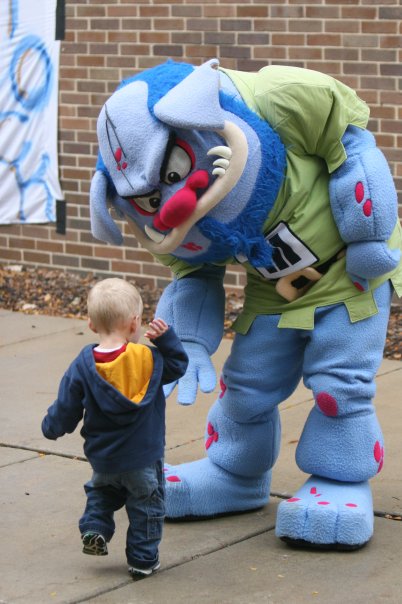
Some mascots are not what I would imagine when I thought of the school. I was surprised to see that Trinity Christian College chose the "Troll" (left) as their mascot. Seems an odd choice. He is kinda wild looking, in a Saturday morning cartoon kind of way.

Not to be outdone, the students of Webster created their own mythic mascot: a Gorlok (below). According to Wikipedia, "The Gorlok is Webster University's school mascot. It is a mythical creature that was designed by Webster staff and students through a school contest. It has the paws of a cheetah, the horns of a buffalo, and the face of a Saint Bernard dog." Lest you wonder what such a creature would look like, I have added a picture below. (The in-person mascot looks a lot more cat-like.) Too much Star Trek for the students of Webster, hmm? ("The Gorloks are attacking, captain!" "Set phasers to stun!") I have to say, between the Troll and the Gorlok, I would be shooting for the Troll.

In this day of student athlete arrests, it is somewhat foreboding to name your team the Vandals (Idaho), Bombers (Ithaca), Chokers (Grays Harbor College), and Dirtbags (Long Island State baseball). I find it ironic that only one school claimed its athletes to be Gentlemen--the men's teams from Centenary--and they changed their mascot in 2007 to the Louisiana Catahoula--a very cute dog. Their women, of course, were the "Ladies," though they share that (previous) title with the women athletes at Kenyon College (whose men were more impressively named "Lords").

The real question, of course, is: Does the mascot name bear any relationship to how well a team does in the Big Dance? You can read through the list of championship teams and play a 2-player version of rock-paper-scissors, comparing the scariness of the mascots for each team to see if that justifies the win. For example, last year's champs, the Blue Devils, do seem more threatening than the Butler Bulldogs, with the supernatural angle and all.  Clearly, alligators would maul a buckeye (acorn like a horse chestnut), as they did in the 2007 game, but it may be hard to determine if the Florida Gators should have beaten the UCLA Bruins in 2006. Those of us without zoology degrees can get a hint from the television show "Animal Face-Off," which showed a simulated encounter between an alligator and an American Black Bear in the wild. In that version (you can watch it here, if you can stand it), the bear won. Unfortunately, it seems that a mythical bear beats an alligator in basketball.

I would encourage you to review your brackets and see which threatening and/or impressive team mascot should win the game. Hey, you can't do any worse than my current brackets!

Saturday, March 12, 2011

Dean for a Day

I am participating in the Pseudonym Exchange Blog, and I just did my first identity-switching post. I tackled an administrative question about student advisory committees from an interested reader in the style of my good friend, Dean Dad. I hope I do him justice, though he is far more sophisticated and thoughtful about administrative matters than I will ever be.

Check it out here.

Saturday, March 05, 2011

Reflections on a national LGBTQ Higher Ed conference

Timo Elliott picture of MOMA and skyline reflection
I have to say that after three days of fantastic panels, speakers, and workshops, I am well and truly exhausted. I came back to the room to work a little, and I can't even focus. My mind is reeling from the presentations and ideas, and I find myself just wanting to chill out and reflect.

This conference is one of few that brings together faculty, administrators, queer studies scholars and researchers, LGBTQ resource center professionals, national higher education group leaders, LGBTQ activists, and student affairs staff members in one venue. It becomes clearer that this is the coalition we need to affect change on university and college campuses. In small and large groups, we have networked, problem-solved, shared best practices, and communicated about our hopes and our challenges in trying to effect change in the academy.

The plenary speakers* have been outstanding. (*I missed one, so I cannot report on that speaker, but I will discuss all of the others.) On Thursday night, Anthropologist Gil Herdt discussed the history of LGBTs in the United States, discussed the transgressive potential of current policy initiatives (DADT repeal, ENDA, DOMA repeal, etc.), and laid out a plan for advocacy and organizing for comprehensive sexual health.

Herdt's message was challenged/complemented by one of Friday's plenary speakers, Kenyon Farrow, former director of Queers for Economic Justice, who criticized the traditional single-issue organizing approach most popular among our big national queer groups on behalf of a multi-issue, diverse people. Farrow reminded the conference attendees about the needs of homeless queer youth, queers of color, working-class and unemployed queer people, and other groups we privileged academic queers can tend to forget. He shared stories of queer, homeless, youth of color in New York City whose very existence has been criminalized; of HIV educators who have been arrested for loitering or been mistaken for sex workers; of transgender people who have been arrested as sex workers simply because they were transgender and carrying condoms on their person. Among the many issues he highlighted as most pressing were: AIDS and HIV (still a challenging issue, with very high rates of infection among men who have sex with men); health care reform; homeless queer youth; economic issues more broadly; and the larger criminal justice system, including prisons.

Farrow also discussed the challenges to organizers of remembering to engage in self-care, in staying connected to and nurturing personal sources of support, and in staving off burnout. He challenged academics to reach outside the academy to other LGBTQ communities that do not have access to higher education, which might also help us stay current with the issues that matter to the many LGBTQ communities.While Farrow didn't have all the answers, he did ask a lot of the right questions for those of us interested in maintaining and growing an active, energized, multi-issue social justice movement.

Perhaps the most moving plenary speaker was Sivagami "Shiva" Subbaraman, Director of the LGBTQ Center at Georgetown University. A product of Catholic education in India, an out lesbian who had once been heterosexually married, and a practicing Hindu, Subbaraman described ways to incorporate Ignatian philosphy, upon which Jesuit practice is rooted, into both the pursuit of a queer, social justice and support for LGBTQQ students in our institutions. She discussed how an approach to facilitating discernment and flourishing in our students can lead to their develop as a whole person. This struck a chord for me, as someone who has seen LGBTQ students really struggle with their spiritual and intrinsic selves, within and apart from their LGBTQ (and other) identities. She encouraged all of us to build on our own imaginations, as an engagement with "what is" is necessary to imagine "what may be" in the communities we desire to build. She challenged listeners to reach out in our relations to others and the larger world--especially those with whom we profoundly disagree, to move from a space of tension and contradiction to an acceptance of paradox and mystery.

The final plenary offered today by Genny Beemyn and Susan Rankin, presenting on their amazing study of transgender populations. They have a book coming out in fall, The Lives of Transgender People (Columbia University Press), which is based on the results of "the first large-scale, national study of transgender people in the United States." More than 3,700 transgender people responded to the online survey, with almost 300 telephone qualitative interviews. Beemyn and Rankin were able to identify different subgroups within the transgender population, often associated with age cohorts, race and ethnicity, and labeling of oneself, that corresponded with specific experiences of identity formation, milestones, and conceptions of one's self and one's gender. Just based on the information they shared in the presentation, their findings could impact programming, policies, and practices on campuses and in communities around the country. I am eager to read the book when it is published this fall.

Tomorrow's sessions include a plenary about being a straight ally and a session on building a research infrastructure on LGBTQ issues in education by George Wimberly, the director of social justice and professional development in the American Educational Research Association.

Final takeaways from the conference (which isn't quite over) for me?
  1. We need to get sexual orientation and gender identity and expression on the common application for college, along with the NSSE (National Survey of Student Engagement), so we can find out about LGBTQ students on our campuses and have some idea of the overall population from which we sample for our smaller studies. (Rankin noted that individual schools can add questions to the NSSE, so see if you can get these demographic questions added on your campus survey!)
  2. For those who want to create good teaching rubrics, check out Rubistar.com. It is free and fantastic! (No, there isn't anything especially queer about it, but gotta pass on a good idea when I find it!)
  3. We need to keep working across lines--disciplines, contingent and TT/Tenured faculty, student and academic affairs, faculty/staff, etc. to really effect changes on campuses, and that can only work if we try to take that approach in everything we do on campus. 
  4. We are never to old to grow and learn something new. And we should make sure to laugh... a lot.
Yes, I am leaving the conference excited, happy, refreshed, and energized by all of the fantastic ideas and work going on out in academe. I couldn't have asked for more.

If all this sounded good, save the date for next year's conference: March 8-11, 2012 in San Francisco. Perhaps we really can have a meet up! Drinks are on me.

Wednesday, March 02, 2011

The queers are here... and they are ready to dialogue!

I have just arrived in San Francisco for the Expanding the Circle conference, a specialized conference on LGBTQ issues in higher education. The multidisciplinary conference, which starts tomorrow, covers many topics dear to my heart, including making universities more welcoming to LGBTQ students, faculty, and staff; religion and spirituality in queer communities; and queering the curriculum. Plenary speakers include folks from Queers for Economic Justice, the National Sexuality Resource Center, and feminist writer and activist Judy Grahn.

I am excited to be surrounded by so many queer folks. In fact, in the lobby when I was checking in, there were queers everywhere! Now, it may seem silly to write this in San Francisco, a city that is often considered the queer mecca. (At least, it was at one time, before towns in most states all over the country starting developing into their state's queer magnet: Durham, NC; Amherst, MA; Atlanta, GA; Seattle, WA, etc., I am talking to you!)... But there is something about going to a "boutique" queer conference in an actual boutique hotel that is intoxicating. Nothing like being surrounded by effete nancy boys, butch academic dykes, and the full range of gender/class/race/ethnicity at play.* And the damn thing hasn't started yet!

I am looking forward to meeting the other attendees and hearing the presentations. I really don't want to skip anything; there is at least one session during each time frame that is interesting to me! I haven't been able to say that at a conference in my discipline for ages. And with an attendance of 150-200 people, I am hopeful about to getting to know a number of folks here.

I have only attended a few LGBT-focused conferences in my time as an academic, and each brought with it the heady opportunity to meet and hear from the famous academic queers of the time. The first multidiscplinary/queer studies conference I attended was during my student days, and it was a blast. I couldn't afford to fly, so I drove across the country with someone I met online (to share expenses), stayed with a local grad student, and bought fast food and snacks to save on cash. I still remember the excitement of hearing famous scholars presenting at the height of their (early) fame:
  • Judith Butler (incredibly smart, well-spoken, and she had great (defined) arms; she reminded me a little bit of a bartender in an old-fashioned dyke bar, which some of you will understand is a compliment, especially coming from someone who was a serious baby-dyke at the time)
  • Michael Berube (smart and funny) 
The idea that I got to present my little paper at the same conference was amazing to me. I attended another small gathering hosted by CUNY's CLAGS program about the future of LGBT studies. There I got to hear from and speak with:
  • Amber Hollibaugh (well-spoken and quite a presence, but she didn't look as I had imagined)
  • John D'Emilio (very low key, funny, and smart)
  • Ellen Lewin (old guard at this point, she was a very cool customer in facing what I considered immature castigation of women's studies)
Looking back, I am still struck by two stories: (1) D'Emilio talked about running in a marathon to bring in money for the LGBT studies program; you gotta respect that. (2) Several faculty discussed strategies to get offer LGBT-related courses. Suggestions included putting anything "queer" after the colon, so it wouldn't show in students' transcripts; getting all the queer students to sign up for a class and drop it late, so the course would make, even with a small number of students. It was kinda sad.

There don't seem to be so many queer conferences these days, especially multidisciplinary ones, so I am treasuring this experience. I hope it lives up to my expectations. And who know who I will see? I don't think I will be as star-struck as I used to be, but it is always strange to meet someone who you know only by their academic work. I can see myself thinking, "Ah, so you are Herdt, G."

I, of course, will not be out as Lesboprof to any of the other folks at the conference, but if anyone who reads this is here for the conference, I am always up for a nightcap or a cup of coffee. Drop me an email at lesboprof@gmail.com and perhaps we can meet IRL!

Whistles as I get ready to meet a famous lesbian colleague for dinner on the town.
 

* Yes, that was a gratuitous Judith Butler reference. What can I say? I am trying to get in the queer studies frame of mind.